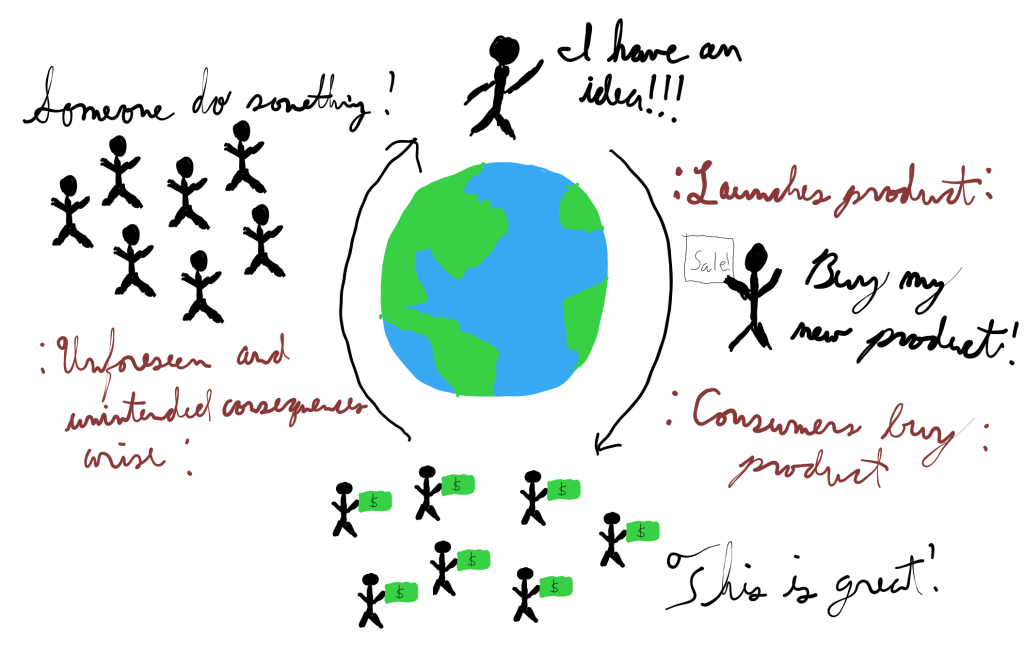
Transitions take time

The appearance of the first Model T didn’t immediately kill the horse and buggy.

The light bulb didn’t render candles obsolete overnight.

Technological transitions are not step functions. There is no sudden change, no instantaneous jump to a new, higher value of technology. Instead there is a gradual transition that eventually results in a full switch from the previous technology to the next. The slope is not smooth either – there are plenty of bumps along the way.

Sometimes that full switch takes years. Even decades.

We are in a period of significant transition across all of our technologies.

Don’t write off the newcomers. Don’t force them either.

They will find their own way in time. Be patient.

Earth First

I start my day in the shower using soap from the United States, eventually drying myself off with a towel from Turkey or Pakistan, and then I shave using shaving cream from Canada.

I dress myself with clothes from Vietnam, Malaysia, or Bangladesh (all of which were washed in a washer and dryer from the United States), before heading to work in my vehicle made in Japan.

Before departing I grab my headphones and cell phone that were made in Vietnam, both of which were charging through an electrical outlet made in China that is connected to Romex wiring in my walls made in the United States. That wiring attaches to an electrical panel from either the United States, Mexico, or China.

I bring a lunch to work each day. In my kitchen I find limes and asparagus from Mexico, kiwi from Italy, chia seeds from Paraguay, Ramen from China, potatoes from Canada, quinoa from Peru, and bananas from Guatemala, all of which are stored in appliances and cabinets from the United States.

I use my cutting knives from India to prepare my meals, which I cook on cookware from the United States when I’m using the stovetop, or on a baking sheet from China (with a silicon baking sheet from France) in the oven. If I’m packing for work I’ll store my food in Tupperware from the United States that goes into a lunch bag made in Vietnam, but if I’m eating at home I’ll use plates from Indonesia and bowls from China.

Hey, look, I also found a bottle of water from Fiji hiding in the back of the pantry (more on the absurdity of this particular product in a future post).

What else can we find?

My workshop has drills from Japan, nails from India, nail guns from the United States, and a chainsaw from Germany.

I write draft posts on a legal pad made in India (or in a notebook from the Philippines), with a pen from Tunisia, before typing those words on a keyboard made in China connected to a computer made in Vietnam. I typically store my computer, legal pad, notebook, and pens in one of a few bags I own that were made in the Philippines.

For those who lost track, that is 21 unique countries spanning 6 continents.

I can connect with someone across the planet in less time than it takes me to walk next door to say hello to my neighbor.

The oxygen that my lungs are absorbing in this very moment – molecules are physical things, after all – came from air that ignores the arbitrary lines we draw on our fancy maps. It came from somewhere on this planet, but that’s slightly harder to pinpoint.

We are one world.

Earth must come first.

The transition will be rough – but inevitable.

Get on board.

The Abundance Illusion

Full tank of gas? It’s NASCAR, baby! Let’s go!

Running on empty? Drive it like Grandpa stole it.


New tube of Toothpaste? gimmie all the mint!

End of the tube? squeeze it, roll it, press it until you get that last little bit, and that’s good enough to brush with.

Same with shampoo. Or soap. Or anything else in a tube or bottle or container.


We don’t realize how little we truly need until the stockpile is nearing depletion.

In most cases we can’t truly know what remains. Any idea how many fish are left in the ocean? I certainly don’t. Yet our default is to the abundance mindset, believing the cache is bountiful, when in most cases it isn’t.

ย You require much less than you realize. Pay attention. Use less.

Notice of Annual Rent Decrease

Imagine a world where a landlord sends this letter to their tenants:

“Because I had such a great investment year and my needs are well covered, I am reducing your monthly rent by 5% for the next year, at which point we will reevaluate.”

A preposterous thought, right? I mean – what landlord in their right mind would offer such a ludicrous deal? A rent decrease? Not in our growth-minded system.

Pull that thread a bit. See what answers come to you. How did we come to believe that this concept is so ridiculous? Why is there a constant demand for growth that drives our current behavior?

Maybe it only seems crazy to us because the suggestion runs counter to our current mental models. What if we changed the system conditions to allow for it?

The earth no longer provides for us…

…at least not willingly.

Let us imagine a world where you can step outside your door and grab something nourishing to eat, at no cost to you, directly from nature. As an experiment, venture outdoors and see what you can find.

Chances are, you won’t find anything.

A home garden doesn’t count in this scenario. Gardens require considerable human input to generate food. We must coax the nutrients from the earth to sustain ourselves, because the earth is stubborn when it comes to growing what humans eat. I’m challenging you to find an unprocessed food source that occurs naturally in the wild that we can simply eat. I’m willing to bet that – excluding gardens and farms – you’d walk miles and still be unable to find a source that can sustain you. Hunters may have better luck, but what about the rest of us?

We’ve been relying on agriculture to sustain us for thousands and thousands of years, so I’m not necessarily surprised by the results of this experiment. What is concerning, however, is that over the course of those thousands of years, we’ve clearly been forgotten by the earth. We decided our way was better, and she has shifted her attention elsewhere to provide for other species.

If there were ever a long-term warning sign – relatively speaking – that our time has come, that our reign as apex species is over, this is it. The fact that this earth no longer naturally provides – in abundance – that which we need to sustain ourselves.

Grow more. Fence less.

As another growing season comes to a close, I lament the loss of the vegetable plants consumed by the animals with whom I share a yard. Carrots, kale, spinach, and lettuce, all wiped out in a matter of days early on in the season, unable to regenerate because animals typically consume the entire plant.

Consequently, I’ve identified a new strategy for next year: grow more.

I reject the notion that I must create secure, impenetrable garden beds for the food I eat while leaving the majority of my open space meticulously manicured (and useless).

Animals are hungry, just like us, and given the lack of groundhog grocery stores in the immediate area, I can take the hit, devote a larger percentage of my yard to growing more, and give back to my roommates.

Nature can thrive “over there”

Our greatest challenge as a society is to convince ourselves that undeveloped land provides more value when left alone.

In pursuit of perpetual growth we continue to reshape the natural world, operating under the errant assumption that undisturbed nature can simply exist “over there.” What we fail to realize is that people “over there” are behaving similarly.

Roots through a walkway

The quintessential representation of mankind versus nature: Roots from a tree incessantly pushing through mankind’s pristine paved surfaces.

Mother nature’s victory is inevitable, for we may attempt to retaliate with repair and maintenance, but our efforts are futile and we will tire from the fight.

A human lifetime is merely a speck on mother nature’s timeline. As our resolve to continuously support our artificial creations dwindles, mother nature will remain resolute.

The grass may be greener…but does that make it better?

The answer to this question depends on your perspective.

Driving through a neighborhood today, I came across two adjacent lawns. The first was a pristine, verdant lawn that was worthy of a magazine cover. The second lawn was left to grow naturally.

The former may be appealing to the human senses (not mine), but the latter had the birds. So many birds, in fact, that the lawn appeared black at first glance. What was even more intriguing was the dividing line between the two lawns, drawn not by a fence, but by the abrupt end to the birds at the edge of the natural lawn.

They wouldn’t venture into the green grass. There is nothing for them there.

The red onion resurrection

Ever buy something at the grocery store only to find you already had it in the pantry? I did that with a bag of red onions recently.

I ate them as quickly as I could – onion breath for days – but still, a few started to sprout.

One of the more mature sprouts had started to die, but I decided to plant it as an experiment anyway. To my surprise, the plant actually revived itself. The brown sections that I planned to trim are now lush and green.

Incredible resilience. I was fascinated to watch the resurrection.

Don’t be too quick to write things off.

And for those of you paying attention to the timestamp, it is in fact winter,
which means that yes, there is a huge pot in my kitchen with an onion growing in it…

Plant a seed. Watch it grow.

A few years I started a vegetable garden. I started with a single small pot first – a trial run since I wasn’t quite convinced I could keep plants alive. I passed that test, and this past growing season was quite rewarding. You should try it sometime. Here’s why:

  1. It’s therapeutic.
  2. The growing process is astonishing. Put a few seeds into fertile soil. Water. Harvest. Voila. Nutritious food arises from the ground, growing from seeds the size of a nail head. Great things sprouting from what seems like nothing.
  3. Nothing compares to fresh vegetables. Not store bought fresh – right off the plant fresh.

Plant a seed and watch it grow. You’ll grow as well.